PPS-24-Briscala
Pesic Marco
In this project, I am responsible for the structure of the EngineController,
the implementation of view mixins (specifically TableView and TurnHistory),
and the implementation of WinRules with support for team-based games.
I’ve worked on the following files: EngineController, TableViewManager, TurnHistoryManager, and GameElements (Team and WinRules).
Engine Controller
This class implements an event-driven, functional-style controller.
It orchestrates interactions between the game model (FullEngineModel) and the GUI view (EngineView) using a custom State[Window, A] monad to handle side effects in a composable, purely functional way.
The only public method is start which initializes the game by setting up the view and rendering the initial state of the game.
 override def start(): Unit =
    val initialState =
      for
        _ <- view.addTurnHistory()
        _ <- view.addTable()
        _ <- model.players.foldLeft(unitState(): State[Window, Unit]):
          (state, player) =>
        for
          _ <- view.addPlayer(player.name, model.players.size)
          _ <- state
          _ <- renderHand(player)
        yield ()
    _ <- checkBot()
    yield ()
The window event handler is defined as a State[Window, Unit] that processes events from the window, such as clicks on specific components.
val windowEventsHandler: State[Window, Unit] = for
    events <- windowCreation
    _ <- seqN(events.map(event =>
        val parsedEvent = parseEvent(event)
        parsedEvent match
        case Left(error) =>
            println(s"Error parsing event: $error")
            unitState()
        case Right(CardPlayedEvent(playerName, card)) =>
            handleCardPlayed(playerName, card.name, card.rank.toString, card.suit)
        case _ =>
            println("Invalid event received")
            unitState()
    ))
    yield ()
The handleCardPlayed checks whether the player exists in the model and then moves the responsibility for checking the turn validity to the model through the playCard method.
private def handleCardPlayed(playerName: String, name: String , rank: String, suit: String): State[Window, Unit] =
  val card = CardModel(name, rank.toInt, suit)
  model.players.find(playerName == _.name) match
    case Some(player) => playCard(player, card)
    case None =>
      println(s"Player $playerName not found.")
      unitState()
The playCard method updates the game state and the view accordingly, and then calls endTurn to advance the game to the next player’s turn.
    private def playCard(player: PlayerModel, card: CardModel): State[Window, Unit] =
      if model.playCard(player, card) then
        println(s"${player.name} played ${card.name} of ${card.suit}")
        playerTurn += 1
        for
          _ <- view.removeCardFromPlayer(player.name, card)
          _ <- view.addCardToTable(player.name, card)
          _ <- endTurn()
        yield()
      else
        unitState()
The difference between a BotPlayerModel and a PlayerModel is that the bot player automatically plays a card when it’s their turn, by not passing through the eventHandler .
    private def playCardProgrammatically(bot: BotPlayerModel): State[Window, Unit] =
      val card: CardModel = model.botPlayCard(bot)
      for
        _ <- handleCardPlayed(bot.name, card.name, card.rank.toString, card.suit)
      yield()

    private def checkBot():State[Window, Unit] = {
      model.activePlayer match
        case bot: BotPlayerModel if bot.hand.view.nonEmpty => playCardProgrammatically(bot)
        case _ => unitState()
    }
View
WindowState
To integrate Java Swing with minimal Java code, a SwingFunctionalFacade is implemented. This facade exposes only essential methods
WindowState serves as a functional wrapper around the Java facade. It maps each facade method to a corresponding state transformation. Additionally, it introduces a Window type alias to abstract away the underlying java.awt.Frame type, reducing direct dependency on the Java Swing library.
EngineView
The EngineView singleton provides high-level methods that the Controller uses to update the View’s state. Each method returns a State[Window, Unit], enabling their composition via for-yield blocks when constructing or updating the View.
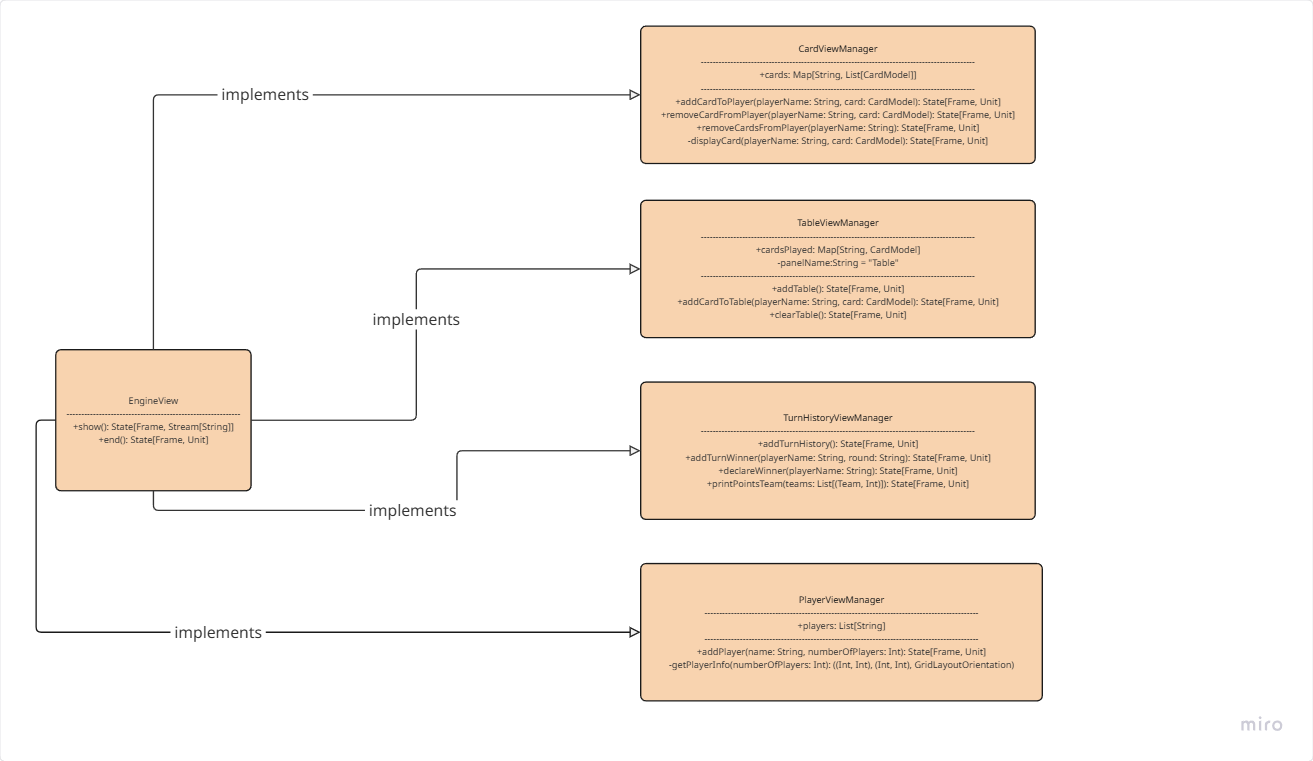
sealed trait EngineView
    extends PlayerViewManager
    with CardViewManager
    with TableViewManager
    with TurnHistoryViewManager:
  def show: State[Frame, Stream[String]]
  def end(): State[Frame, Unit]
Team and Win Rules
A Team is a List of Player names
type Team = List[String]
We set up every game such that every player is a part of a team, composed byy himself if not explicitly assigned to a team. This allows for flexibility in team configurations, such as single-player games or games with multiple teams.
The ‘Win Rules’ is implemented as a lambda that takes as input a list of teams and the list of all players in the game and returns an ordered list of teams. The user can create their own custom win rules by defining a lambda that matches this structure:
(List[Team], List[PlayerModel]) => List[Team]
To make their definition easier in the DSL, some basic rules have been created that can be used by specifying the context with the given/using syntax in the following way:
(teams, listOfPlayers) =>
        given List[Team] = teams

        given List[PlayerModel] = listOfPlayers

        highestPointTeam
This allows users to define custom win rules that can be tailored to specific game variants or preferences, while still adhering to the overall game structure and logic. Two basic win rules have been implemented: highestPointTeam and lowestPointTeam.
  def highest(using
      teams: List[Team],
      players: List[PlayerModel]
  ): List[Team] =
    val playerScores = players.map(player => player.name -> player.score).toMap

    // Calculate the total score for each team
    val teamsWithScores = teams.map(team =>
      val totalScore =
        team.map(playerName => playerScores.getOrElse(playerName, 0)).sum
      (team, totalScore)
    )

    val orderedTeams = teamsWithScores.sortBy(-_._2).map(_._1)
    orderedTeams
| Go Back to Implementation | Index |